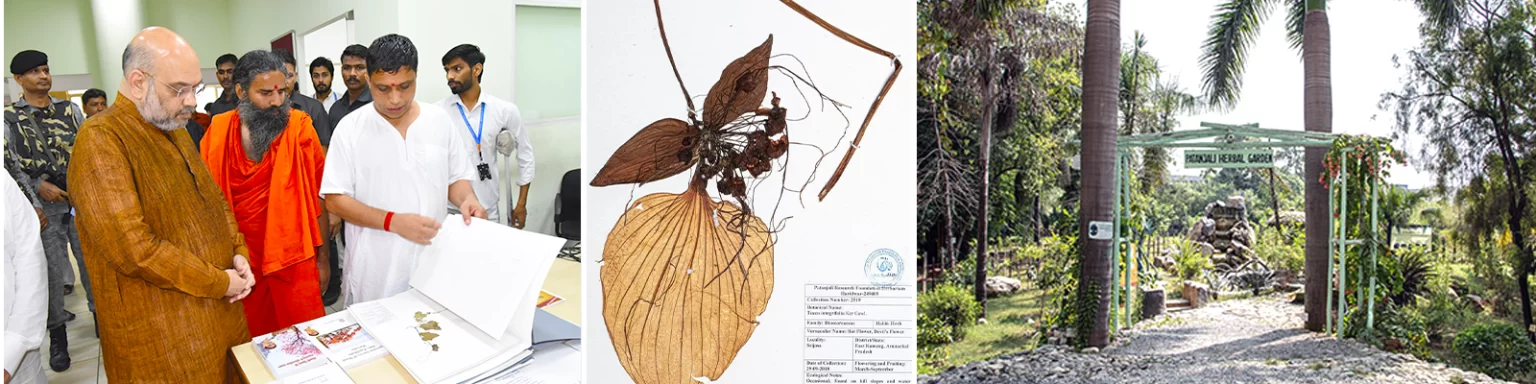
Under the learned guidance of H. H. Yogrishi Swami Ramdevji, Vaidyaraj Acharya Balkrishna and Swami Muktanand, Patanjali Herbal Garden & Agro Research Department has been established at following few sites- Patanjali Herbal Garden Site Nursery, Patanjali Herbal Garden site Gurukul Gaushala Farm, situated nearby Patanjali Yogpeeth at Maharishi Dayanand Gram, Bahadrabad, Delhi-Haridwar highway. These Herbal Gardens have beautiful collections of more than 200 medicinal herbs, shrubs, trees, climbers and ornamental plants. Since, 1997 it was a great effort with high spirit to collect the valuable medicinal plant and to ensure to grow in Garden, a Divya Vanaushadhi Vatika has been earlier established in the Ashram at Kankhal. Thereafter, to explore more possibilities of a large number of wide collections, exposition and research of medicinal, aromatic and ornamental plants in a organized way in the Patanjali Herbal Garden has been established. A team of Scientists from Botany and Agriculture and a number of swayam sevak are engaged for research and management.
Collaboration in Research with National Bureau of Plant Genetic Resources (NBPGR) and Research on Astavarg plants:
In 1997 Swami Ramdevji visited NBPGR, Head Quarter at New Delhi and later research collaboration has been made on Plant Biodiversity to survey, identify and collect Ashtavarga plants used as ingredients in Chayavanprash. This project provided a good opportunity to undertake exploration and collection tours in Hilly areas of Uttarakhand and Himachal Pradesh and about 120 medicinal and aromatic plants were collected and planted in the Divya Vanaushadhi Vatika.
Over the past two thousand years, Ayurveda lost its glory and the thrust of Unani and Allopathic systems on Indian society and as a result there are much valuable wisdom of medicinal plants has been lost. The great invention of Ashwani Kumar brothers on the Astavarga group plants used as rejuvenators of body of Rishi Chayavan through the preparation of Chayavanprash. Over the vast time gap, the Ayurvedic experts had lost the actual identity of these eight plant species which formed the ingredients of Chayavanprash.

The information contained about them in the literature had been full of misidentification and wrong. It was only due to these plant species grow in small patches in difficult areas in the northwest Himalaya. Most of the time, it seems, the Ayurvedic experts did not extensively surveyed the areas of Himalayan elevations rather relied on wrong information provided by cunning traders or collectors. Herbal-img3Basically Astavarg is the group of plants described as jeevaniya , brhneeya, vaya sthapanix in various Nighantus are viz. Jeevak, Rishbhak, Meda, Mahameda, Kakoli, Kshirkakoli, Ridhi and Vridhi.
The Astavarg is a cooling, tasty, nutritious tonic, aphrodisiac, nourishes body and increase kapha. It is beneficial in seminal weakness, increases fat in the body, heals bone fracture and cures vata, pitta and rakta doshas, abnormal thirst, burning sensation in the body, fever and diabetic condition. It is one of the excellent combinations of herbal drugs which restore health immediately, strengths immunity system and cures any disorder in anabolism or body growth process as antioxidants in the body.
Several explorations were undertaken over a period of 4 to 5 years in the altitudes ranging from 2000m to 4000m above mean sea level in the North-West Himalaya. Consequently, it could be possible to re-establish the proper identity of eight plant species of Astavarga used in the Chayavanprash. The book in Hindi and English containing all related information has been published.
The medicinal plants identified as Astavarg are viz. Jeevak- Malaxis acuminata D. Don; Rishbhak- Malaxis muscifera (Lind.) Kuntze; Meda- Polygonatum verticillatum Allioni, Mahameda- Polygonatm cirrifolium Royle; Ridhi- Habenaria intermedia D. Don; Vridhi- Habenaria acuminata Lindl; Kakoli- Roscoea alpina Royle and Kshirkakoli- Lilium polyphyllum D. Don.
The hilly and remote forest areas have been surveyed for specific programme are viz. Auli, Joshimath, Tapovan, Badrinarayan, Valley of Flowers, Hemkund, Ukhimath, Gangotri Valley, Kedarnath, Renthal, Gangnani, Yamunotri Valley, Rishikesh, Dhanaulti in Uttarakhand and Karsog, Jalpa, Kamarunag, Rewalsar, Rewanda, Lahaul-spiti, Hatloo, Thanedhar, Narkanda, Matiana, Shilaru in Himachal Pradesh.
There are a large number of medicinal plant diversity widely used in ayurved are present in the Garden. The live plants are also prescribed by the Vaidyas of Patanjali Yogpeeth to patients for taking fresh extract and decoction according to their dose of administration. Some common species are viz.
There are a large number of Germplasm of many medicinal plants stated above and vegetables shown significant growth and yield like Daucas carrota (Gajar), Lagenaria siceraria (Lauki), Lycopersion esculentum (Tamatar) etc.
The Herbal Garden has infra structures to multiply various plant species of fruits, ornamental and medicinal value and to protect the rare and valuable collections from adverse climatic conditions. These are being used to obtain faster regeneration.
This laboratory is used to prepare herbarium plant specimens, identification of herbs and to take up further research on drying, packaging, and storage of raw herbs. Seed laboratory is used for the process of seed samples for storage to initiate research on storage/packing materials as well as seed viability and seed dormancy.
Large scale growing of various fruits, vegetables and medicinal herbs, shrubs and tree species is being done on about 45 acres of farm land area of the Divya Yog Mandir (Trust). The experimental farming is not aimed at meeting the demand of raw drug material but it is an effort to maintain these plant species for production of seed or planting materials.
Acorus calamus (Vacha), Aloe vera (Ghrit Kumari), Asparagus racemosus (Shatavari), Anacyclus Pyrethrum (Akarkara), Cymbopogon citratus (Lemongrass), Rauvolfia serpentina(Sarpagandha), Withania somnifera (Ashwagandha) etc.
In nature there is a system of maintaining biological balance in soil, air and water. The human intervention has damaged this balance due to short-run gains. This is a great threats towards the sustainability of agricultural production to meet the food and nutritional requirements of growing population. Over the past four decades, the use of chemical fertilizers, pesticides, herbicides, weedicides, excessive soil erosion etc. have adversely affected the soil fertility, productivity and quality of produce. Growing awareness of people about environmental degradation, has led the scientists, policy planners and executives to take corrective steps in order to improve the quality farming. The department has developed Divya wormi compost and Divya NADEP to the farmers for scientific and safe cultivations.
During the exploration and collection trips, the video film has been prepared showing the actual habitats, various plant associations and plant characters of rare and endangered plant species in location like Hemkund, Valley of Flowers, Auli top, Gangotri, Badarinath, Tapovan etc. in Uttarakhand and Saptasar, Rewalsar hills, Kamarunag Rawanda, Hattoo Peak, Thanedhar, Narkanda, Matian, Chail hills in the state of Himachal Pradesh.
A project entitled, “To standardize agrotechniques for Gloriosa superba, Withania somnifera, Rauvolfia serpentina and Andrographis paniculata.” for three years has been sanctioned by the Board.
Research work has been undertaken to propagation and plantation of ornamental plants focuses having medicinal as well as ornamental by using modern nursery techniques.
The department is providing regular training to the farmers. Training of farmers is a tool to improve the economy of the farmer families, to maintain sustainability of the environment, and to involve the farmers for their economic generation. In our demonstration plot of organic cultivation the farmers participating for the organic cultivation. The department provides free of cost training for scientific methods of cultivation.
More than hundreds of people of India and abroad everyday benefited by the department Patanjali Herbal Garden and Agro Research Department through the learning, visual identifying of medicinal plants. The department has action oriented specific programme to train and educate the people by the demonstration and exposition of medicinal plants used for the day to day needs and healthcare. There are also many training programmes conducted by the department in various places of Himachal Pradesh, Assam, Uttrarakhand, Uttar Pradesh etc. The adivasi/ tribal healers, rural practitioners are also taking training to enhance knowledge.
The regular visit of school children in Herbal Garden and getting attention and learning of medicinal plants used for home remedies and to know their ayurvedic and botanical names is most hopeful and our fruitful achievements for the awareness of future generation.
Vaidyraj Acharya Shri Balkrishna has been many times honored as Chief Guest in Herbal Exposition. Recently he trained a group of people more than 250 who were Traditional vaidyas, farmers and practitioners of medicinal plants in Madhya Pradesh. The center has participated for Herbal exposition in various programme and Mahotsav organized in Delhi, Dehra Dun, Lucknow , Haridwar etc. The center has received many praise worthy awards and certificates through the exhibition of Medicinal plants.
Books like Jadi-Booti Rahashya, Vitality strengthening Astavarg Plants, and more than hundreds of articles have been published by Vaidyraj Acharya Shri Balkrishna based on his experiences and research on medicinal plants.